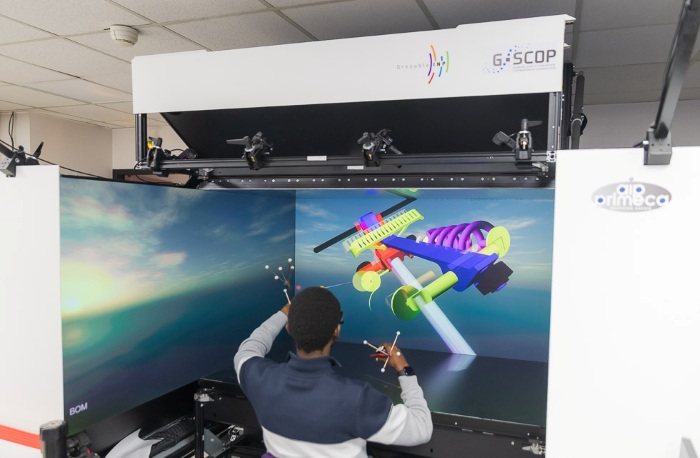


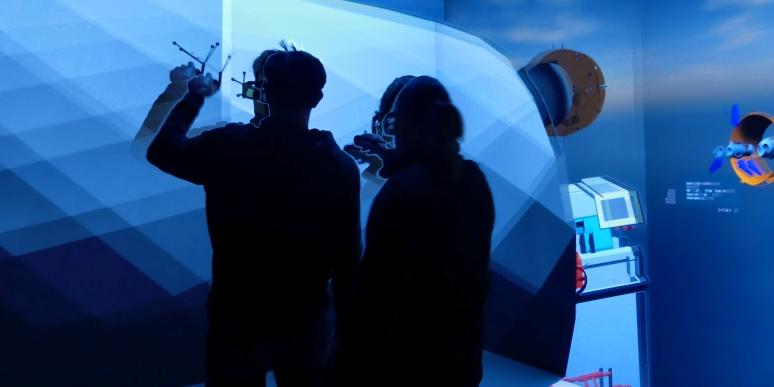
Based on the same principle as traditional CAVEs, such as the CAVE ANGUL-R, the CAVE MIHRIAD offers an immersive space where the walls serve as projection surfaces. Its main differences from the CAVE ANGUL-R are its dimensions and how it operates. Whereas the CAVE ANGUL-R is human-sized, the CAVE MIHRIAD is a smaller space allowing for chest-level immersion without the need for dedicated infrastructure.
Initiated by the G-SCOP laboratory, this equipment was developed with the aim of creating an immersive environment that could be deployed in a design office without the need for specific infrastructure.
Innovative in its minimalist architectural configuration, CAVE MIHRIAD allows for total immersion without the loss of bearings that can occur with virtual reality headsets.
Due to its small size, which is suitable for a standard office, MIHRIAD is a real means of deploying 3D immersion in structures that cannot invest in a building dedicated to a large CAVE.
In addition, its control via a single computer allows for easy operation and is suitable for industrial use. Common processes for navigating 3D scenes, annotation, model measurements and reporting on these activities have already been integrated. Even more innovative uses are currently being developed.
This CAVE was developed in partnership with BARCO, which adapted its screens to the needs of the Vision-R platform, and IMMERSION, which was responsible for integrating the visualisation system. The G-SCOP laboratory, which initiated the project, finalised the system by integrating a motion capture solution.
The MIHRIAD CAVE is an immersive virtual reality environment:
-
A CAVE-type environment is relevant in the context of CAD project virtualisation and 3D manipulation.
-
It also allows for project review, workstation ergonomics studies, 3D visualisation of PLM data and navigation in a 3D environment.
Technical specifications of the MIHRIAD CAVE:
-
This equipment is known as ‘the world's smallest CAVE’.
-
It consists of five screens: one screen in front of the user, one screen above, one screen below, and one screen on each side.
-
Stereoscopic images are projected onto the back of the screens using projectors.
-
A motion capture system completes the device, allowing the user, thanks to tracked 3D glasses, to always have their environment in their field of vision and thus avoid any distortion of the 3D image.
-
Tracked controllers are also available to the user to manipulate 3D objects in their environment.